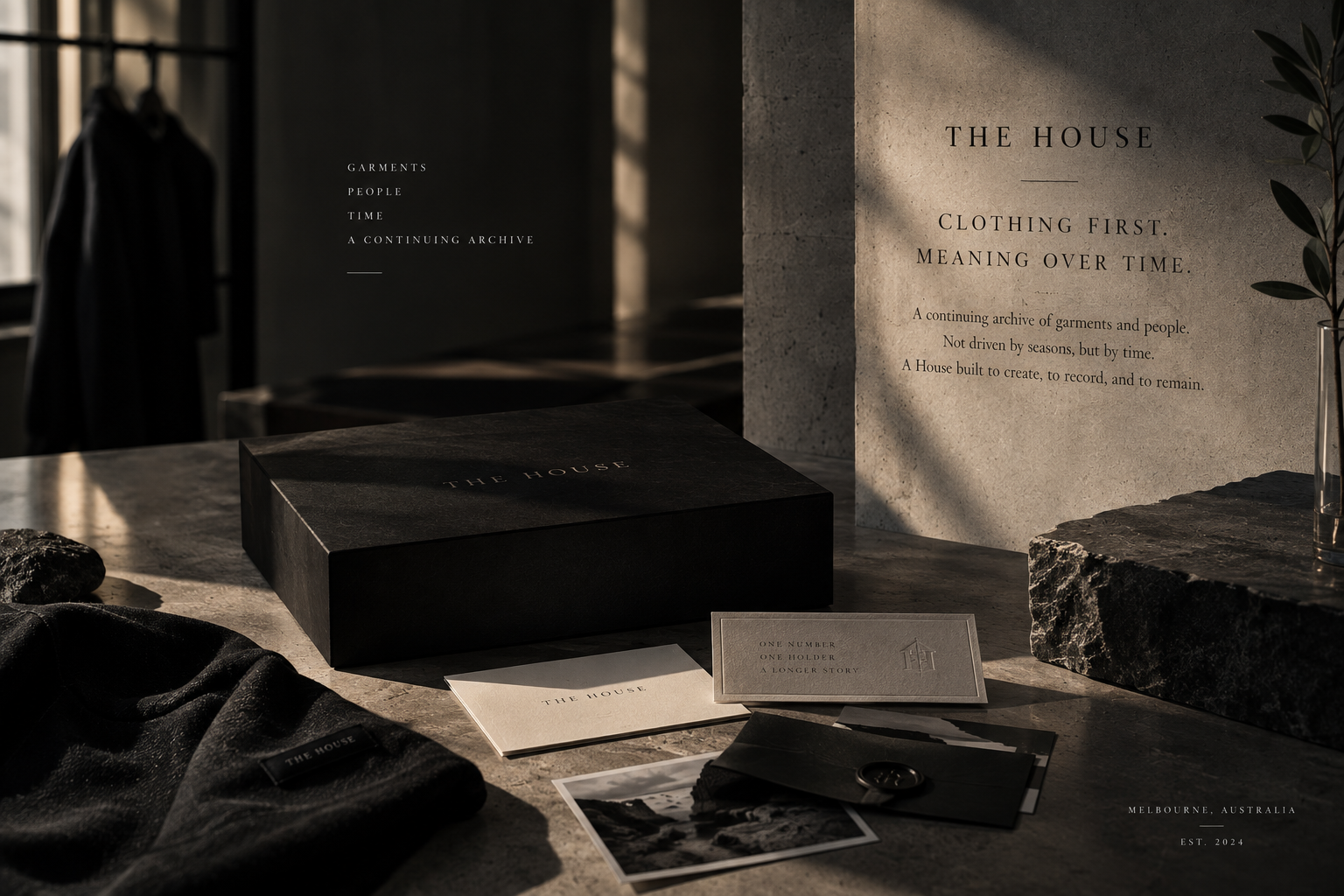
THE HOUSE / OUR BELIEF
CLOTHING FIRST. MEANING OVER TIME.
The House did not begin with the ambition to make more clothes.
It began with a discomfort about what clothing had become.
We had grown accustomed to seeing garments arrive already accompanied by their own expiry date. A new silhouette appears, fills a season, becomes familiar, and is quietly displaced by the next. Clothes are photographed before they are lived in, described before they are understood, and replaced before they have had enough time to become personal. Increasingly, fashion seemed to measure the life of an object from the moment it entered the market to the moment something newer arrived.
But that is not how the things we value most tend to live.
The objects that remain with us rarely remain untouched. A wooden table records the hands that have rested on it. Leather softens around the movements repeated against it. Metal loses the perfection of its first surface and acquires another kind of beauty. A good coat changes almost imperceptibly around the shoulders of the person who wears it. None of these things become meaningful because they stay new. They become meaningful because they do not.
Living in Australia made this increasingly difficult to ignore. There is a particular relationship here between distance, space and time. Melbourne can feel intensely urban and, within a short movement, suddenly quiet. Concrete, old brick, weathered timber, pale afternoon light and enormous stretches of landscape seem to coexist without needing to resolve themselves into one aesthetic. Some of the places that stayed with us most were not the loudest ones. They were small independent stores, studios and rooms that seemed unconcerned with proving their relevance every few weeks. There might be an old cutting table, a rail with only a handful of garments, a drawer of materials and notes, something that had clearly been there for years and had become better for it.
What interested us was not nostalgia. It was confidence.
There was something compelling about an object, a room or a piece of clothing that did not need to become new again in order to remain valuable.
The House began there, with a question that felt almost unfashionable in a culture built around constant replacement:
What if clothing were designed not only for the moment it appears, but for everything that might happen to it afterwards?
That question became the foundation of the House.
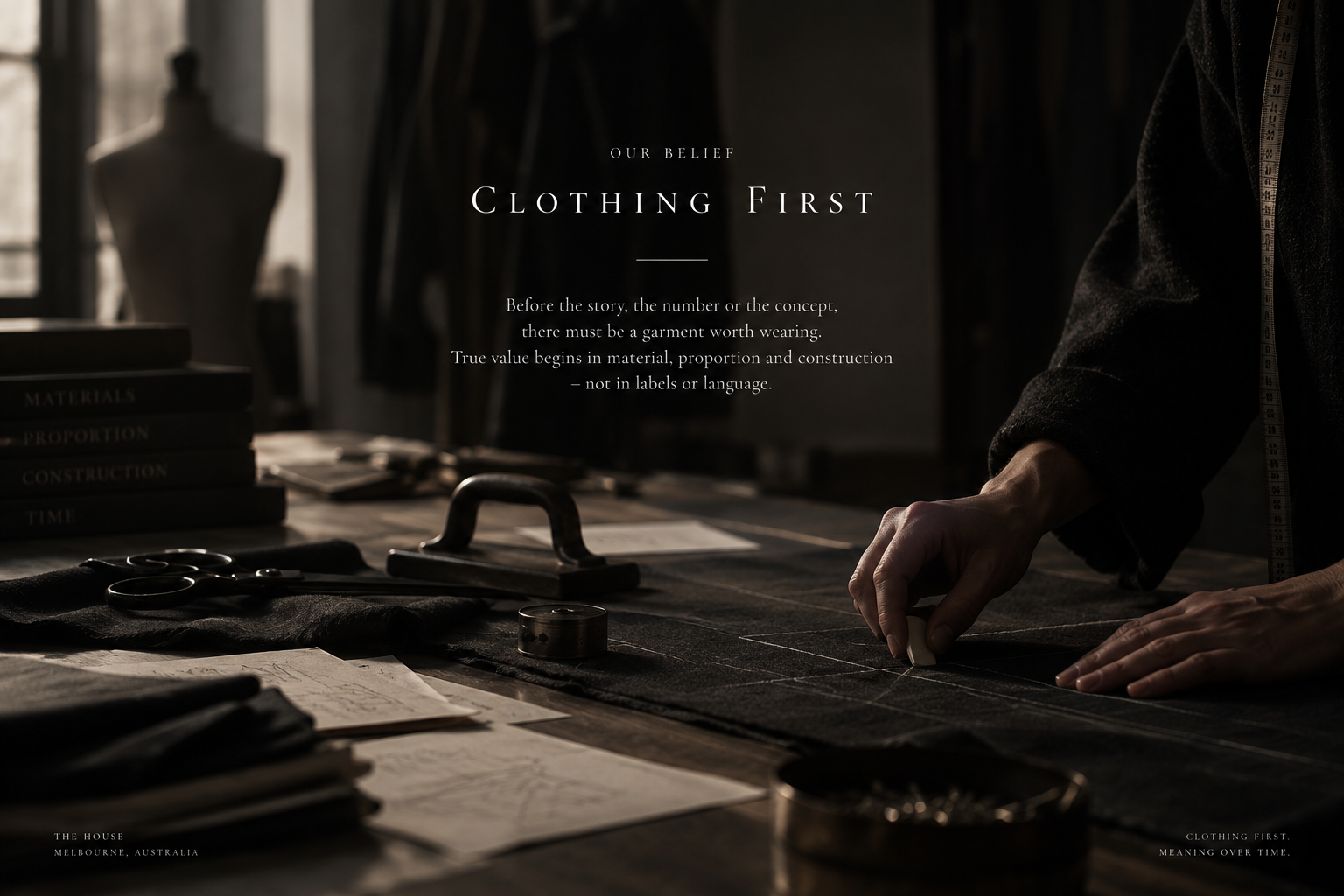
THE HOUSE
CLOTHING BEFORE STORY
Before there is a philosophy, a number, a register or a story, there has to be a garment worth wearing.
This distinction matters to us.
Fashion can make almost anything sound significant. A limited quantity can be described as rarity. An unnecessary construction can be described as experimentation. A high price can be surrounded by enough language that eventually the language begins to substitute for the object itself. We have no interest in that kind of luxury.
No story can rescue a fabric that feels wrong in the hand. No concept can correct a shoulder that falls badly on the body. No numbered certificate can make an arbitrary seam meaningful. If a garment disappoints when the box is opened, everything said before that moment becomes irrelevant.
So the first discipline of the House is simple: clothing first.
We begin with proportion, material and construction. We think about where the shoulder ends, how weight is distributed through the body, what happens to a silhouette when the wearer sits down, how a sleeve changes when the arm bends, how a fabric catches light from a distance and how it feels when held at close range. We care about the parts that rarely appear in campaign photographs: internal finishing, the underside of a collar, the weight of hardware, the edge of a pocket, the way a seam behaves after repeated wear.
These details are not added to make a garment appear expensive. They are the garment.
We are equally suspicious of complexity for its own sake. Complexity is one of the easiest ways for fashion to imitate design. Another zip, another panel, another pocket, another piece of hardware can always be added. Restraint is harder. When a garment is reduced to one decisive line, that line has nowhere to hide. When there is no oversized logo to carry identity, proportion has to do the work. When a piece of cloth is interrupted, cut or folded, there should be a reason beyond the desire to make the garment look “designed”.
The kind of luxury we are interested in is not excess.
It is judgement.
The ability to know what should remain, what should change, and what should never have been added in the first place.
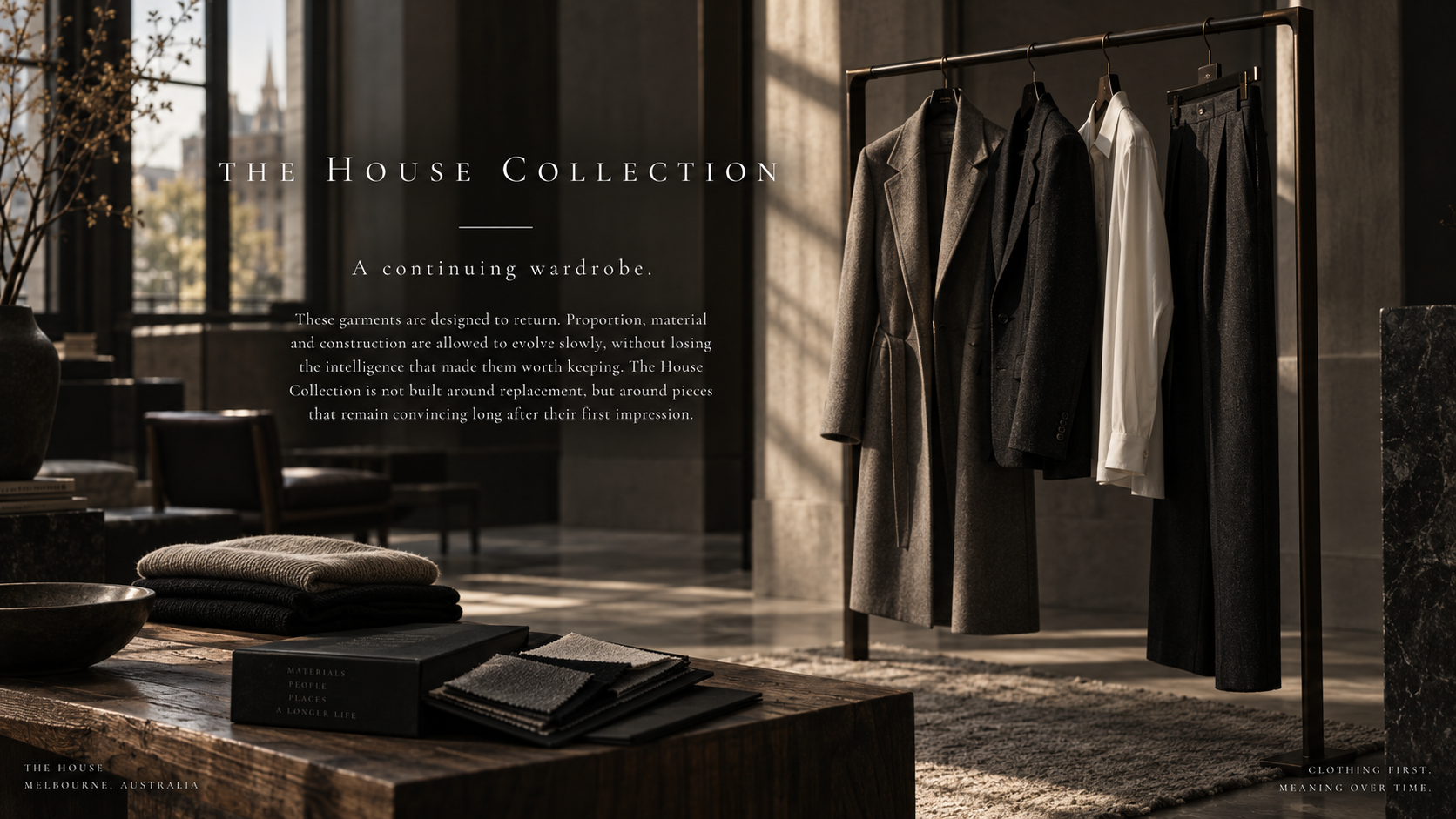
THE HOUSE
THE HOUSE COLLECTION
The House Collection is the most direct expression of that belief.
It is not conceived as a succession of seasons in which every new arrival requires the disappearance of what came before. It is a continuing wardrobe: a language of silhouettes, proportions, materials and constructions that is allowed to develop slowly enough to acquire memory.
A jacket may return years after its first appearance. Its fabric might change. Its shoulder may become quieter. A fastening may move. Its relationship to the body may evolve. Yet something essential should remain recognisable. We are less interested in preserving an object exactly than in preserving the intelligence that made it worth returning to.
We do not use the word “timeless” easily. Nothing exists outside time. Bodies change. Cities change. Taste changes. The circumstances in which people dress change. A garment that refuses to acknowledge this eventually becomes a costume of its own past.
Permanence, to us, means something different. It means being able to change without losing the knowledge of where you came from.
That is the ambition of the House Collection. Not an endless catalogue, but a vocabulary. Not constant replacement, but gradual refinement. A smaller number of garments that become familiar enough to be recognised, lived with and eventually returned to.
If a design still deserves to exist, the arrival of another season is not sufficient reason to kill it. If a design has reached the point where nothing further improves it, novelty is not sufficient reason to disturb it.
We would rather make fewer decisions and stand behind them for longer.
THE HOUSE
THE MOMENT AFTER PURCHASE
For a long time, this seemed enough.
Make better garments. Let them remain. Allow a wardrobe to develop instead of repeatedly beginning again.
But another question slowly became more interesting.
Fashion records almost everything that happens before a garment is sold. The collection. The campaign. The runway. The price. The release date. The stock level. The editorial. The transaction.
Then the garment leaves.
And almost everything that follows disappears from the brand’s memory.
Who chose it? Why that piece? Where did it go? Was it worn once or for ten years? Did it follow someone across cities? Did it become associated with a person, a place, a relationship, a period of life? Was it kept carefully, repaired, forgotten, rediscovered?
For the system that created the garment, none of this usually matters.
For the person who owns it, it may eventually become the only part that matters.
We began to feel that the most interesting moment in the life of a garment might not be its release at all.
It might be everything after.
The Numbered Series emerged from that thought.
THE HOUSE
THE NUMBERED SERIES
Numbers are among the most impersonal objects we have.
They belong to everyone and to no one. They measure time, distance, age, money, rooms, streets, floors, dates and years. Most of them pass through our lives without leaving a trace.
And then, for reasons that are impossible to standardise, one stays.
A room number from a first home away from family. A date no one else remembers. The age at which something ended. The year something began. A seat, a street, a distance, the number worn by someone admired as a child. Sometimes the reason is obvious. Sometimes it sounds insignificant when spoken aloud. Sometimes it is too private to explain at all.
The number has not changed.
The person has placed something inside it.
This fascinated us because it was the inverse of fashion design. A garment begins full of decisions and waits for a person to inhabit it. A number begins almost empty and acquires meaning through the person who chooses it.
The Numbered Series brings those two movements together.
Each number enters the House once through an Original garment and is registered to one Holder at a time. The Holder does not own the mathematical number itself, nor the House, nor the brand’s intellectual property. What they hold is more particular: that number’s registered place within the Numbered Series and the continuing relationship attached to it.
From the moment of assignment, the number stops functioning as a simple product reference.
It begins to accumulate time.
THE HOUSE
THE ORIGINAL
Every number begins with an Original.
The Original is not an existing garment with a different number applied to its chest. If that were all we were doing, there would be no reason for the Numbered Series to exist.
The number must enter the design before the garment is complete.
Its geometry can become construction. A curve can determine the path of a seam. A closed form can become an opening, a volume or a relationship between layers. Repetition can become rhythm. A break in the numeral can become asymmetry. The proportion of two figures can affect balance across the body. At times the influence may be immediately visible; at others it may be buried deep enough that the wearer understands it before anyone looking from the outside does.
The goal is not to make someone say, “I can see the number.”
The goal is to make them feel that the garment could not have arrived at exactly this form without it.
A successful Original should work twice. First as clothing. Then, once its number is understood, as something that can be read again.
That second reading is important.
It means Number 20 cannot simply become Number 21 by changing a graphic. One number should create different design tensions from another. Some will lead naturally toward outerwear, some toward softer forms, some toward an interruption in proportion or an unusual relationship between front and back. The visual language of the House should connect them, but their reason for existing should remain individual.
This makes the Original inefficient by conventional standards.
It requires development. Pattern work. Sampling. Failure. Fittings. Material tests. Ideas that appear powerful in an image but prove unnecessary on a body. Details that have to be removed rather than defended simply because time has already been spent creating them.
We accept that inefficiency.
Because the Original is not valuable merely because only one Holder can occupy its number.
It must first be worth making.
THE HOUSE
VALUE WITHOUT THE THEATRE OF SCARCITY
We are cautious around the language of exclusivity.
Scarcity can be genuine, but it can also become theatre. Produce fewer units, attach a number, increase the price, and suddenly limitation is asked to perform the work that design should have done.
We do not believe rarity can turn an ordinary object into an important one.
The price of an Original should therefore never be justified by the sentence “there is only one.”
Its value must begin elsewhere: in the design work that produced a garment specific to its number; in its pattern and construction; in the material chosen to hold that structure; in the cost and difficulty of making at a scale that does not enjoy mass-production efficiency; in the finishing that remains considered even where it is not visible; and in the responsibility to ensure that the physical object can stand beside the world built around it.
Only after that does the second layer begin.
The Original is not removed from the House after purchase. The relationship does not conclude at checkout. The garment becomes the beginning of a permanent record, and the person who selected it becomes part of that record.
The price therefore cannot be a premium charged for a story.
It has to be the consequence of a system in which the story is supported by the object.
If the clothing does not justify the price, the House has failed regardless of how beautiful the website is.
THE HOUSE
THE HOLDER
When an Original is assigned, the number gains its first Registered Holder.
That is when the Numbered Series changes from a design project into something involving another person.
We deliberately use the word Holder rather than owner. Ownership often suggests complete control over an object. Holding something suggests another possibility: that something may have existed before you, may continue after you, and that for a period of time you are responsible for what happens while it is in your hands.
Each registered number receives a permanent page within the House.
The page is not designed as a social profile. There are no followers, likes, status levels or measures of popularity. A Holder is not more significant because they reveal more about themselves, and privacy is not treated as absence.
A Holder may show a full name, initials, an alias, or nothing beyond the fact that the number is privately held. They may also write the story of why they chose it.
We call this part of the record Why This Number.
For one person, it might be three sentences. For another, several pages. For someone else, it may remain empty for twenty years.
All three are legitimate.
We are not interested in manufacturing sentiment. The House should never require a person to invent meaning in order to make the system feel profound. What matters is simply that when meaning genuinely exists, there is somewhere for it to remain.
Over time, this changes the nature of the Register.
It begins as an archive of garments.
Eventually, it becomes an archive of people.
THE HOUSE
THE REGISTER
Most commerce is built around forgetting.
A product sells out and moves lower on the site. A season passes and enters an archive. Pages disappear. Links die. The brand moves forward by allowing the past to become increasingly difficult to see.
The Register is built on the opposite instinct.
Assignment does not make a number less visible.
It makes the number more complete.
Its page retains the Original, the date it entered the House, the identity the Holder has chosen to make public, and the story they have chosen to leave. If another interpretation is created years later, it joins the record. If nothing happens for a decade, the decade remains visible in another way: as silence.
We consider that silence valuable.
History is not only a collection of events. It is also duration. Waiting. Refusal. Periods during which an object simply remains where it is.
Imagine opening Number 43 fifteen years from now and finding only the Original, one Holder and a short paragraph written in 2027. Nothing else.
We would not regard that page as incomplete.
The fifteen years are part of it.
The House does not need every number to become productive in order to prove that the system is alive.
Sometimes endurance is enough.
THE HOUSE
WHEN A NUMBER RETURNS
There may, however, come a moment when the House sees a number differently.
Years can change the meaning of a shape. New materials become possible. The same numeral can suggest a new construction once the memory of the Original is no longer immediate. A garment created at one point in the life of the House may invite a completely different response later.
When that happens, we may propose another interpretation.
Not a reproduction.
Not a colour variation designed to exploit recognition.
Not the Original brought back because demand exists.
A continuation must contain a reason to continue.
The new work should belong to the same number without pretending to be the same moment. It might change category entirely. What began as a jacket may return as a knit, a shirt, a trouser or something that did not exist in the vocabulary of the House when the Original was made.
Continuity is meaningful only when difference is allowed.
But once a number has been assigned, the decision is no longer ours alone.
The House may create the proposal. We remain responsible for the design, material, production, quantity, pricing and presentation. The Holder does not run the business and does not design by committee.
They hold one decision.
Whether the number returns.
If they agree, another chapter begins.
If they decline, it does not.
This boundary matters to us because it gives the House something brands rarely allow themselves to lose: the automatic right to reproduce what has already acquired meaning.
Not everything that can be made again should be made again.
Sometimes restraint should have consequences.
THE HOUSE
DIFFERENT NUMBERS, DIFFERENT LIVES
Given enough time, the Numbered Series should become increasingly uneven.
That is intentional.
One number may have an Original and five later interpretations. Another may remain untouched. A Holder may approve every proposal. Another may refuse them all. One number may spend decades with a single person. Another may eventually move through several.
The result should not resemble a perfectly organised product catalogue.
It should resemble life.
Separate histories beginning from the same system and moving in directions that could not have been fully planned at the beginning.
We find this far more interesting than producing hundreds of variations and calling them a collection.
A House with age should contain contradictions.
Some doors open often.
Some remain closed.
Some rooms change occupants.
Some look almost exactly as they did years ago.
The structure remains coherent because difference is allowed inside it.
THE HOUSE
PROVENANCE
We have always been interested in the provenance of objects.
An old chair can become more compelling when we know the room in which it once stood. A watch carries something different when its papers, repairs and previous custodians remain with it. A building is never only its architecture; it also contains the people who passed through it.
None of this information changes the physical material.
It changes the way we see it.
The Numbered Series is built with the same instinct.
A Holder may eventually change. Lives change, priorities shift, objects move. If a registered position passes to someone else, we do not believe the appropriate response is to erase everything that happened before.
A new Holder should not receive a false beginning.
They enter a history already in progress.
The Original remains the Original. Previous public records remain part of their period. Earlier continuations remain attached to the number. The new Holder adds to what exists rather than replacing it.
For us, provenance is not an attempt to manufacture mythology around an object.
It is simply a refusal to pretend that the past did not happen.
A number may change hands.
Its history should not.
THE HOUSE
A HOUSE, NOT A MARKET
As the numbers accumulate history, it may become tempting to reduce them to another measurement: price.
We are not interested in building the Register around that.
The House does not need a hierarchy in which an earlier number is automatically more important, a transferred number is automatically more desirable, or a Holder is measured by what someone else is willing to offer for their position.
There may be moments when a registered position changes hands. That is part of the possible life of the system. But the role of the House is to preserve continuity and accuracy of the record, not to turn every transfer into spectacle.
We want the Register to remain a place where someone asks, “What happened to this number?”
Not simply, “What is it worth today?”
There is already enough noise around ownership.
We are interested in what remains when the noise is removed.
THE HOUSE
MADE TO DESERVE ITS PLACE
All of this creates an obligation.
The more meaning a brand asks a customer to attach to an object, the less room that brand has to compromise on the object itself.
The garment must deserve the archive.
That principle should influence everything we make.
We want to work with materials that do more than photograph well; structures that can withstand repeated wear; hardware chosen for weight, behaviour and longevity rather than visual effect alone; interiors treated with the same seriousness as exteriors; patterns considered for actual movement rather than static imagery.
Over time, this responsibility should extend beyond the initial product. Care, repair, replacement of selected components and the preservation of historical records are natural extensions of a House that claims to care about longevity.
We do not want the language of permanence without accepting the inconvenience of permanence.
If we ask someone to keep a garment, we should become better at helping them keep it.
That may take years to build properly.
The point is that the direction is clear.
THE HOUSE
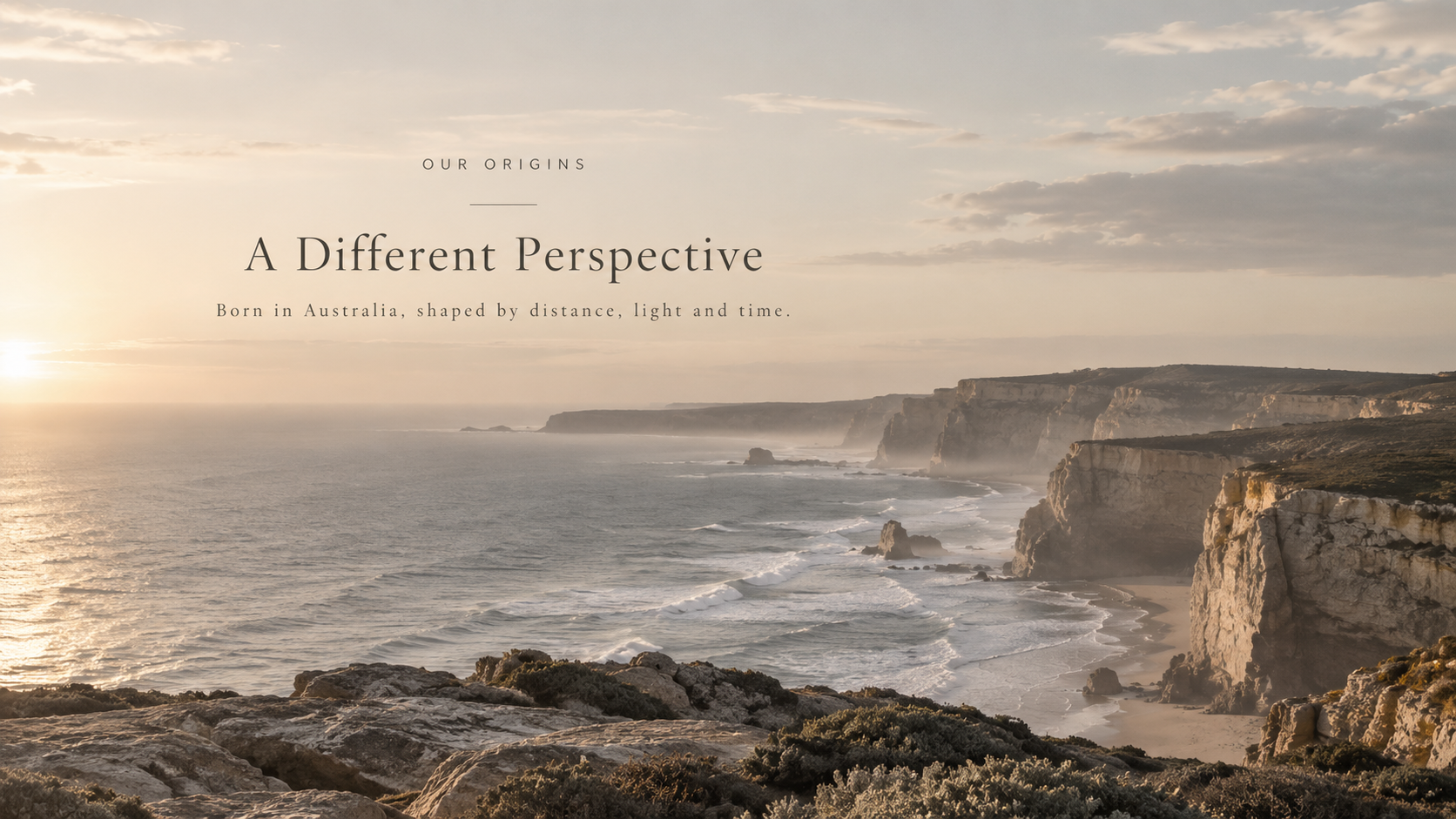
AUSTRALIA WITHOUT SYMBOLS
Australia is part of the House, but not as decoration.
We have little interest in proving origin through obvious symbols. A flag, a map or a familiar animal would tell you where a brand wants to be associated with. It would tell you very little about what living and thinking here actually changed.
What stayed with us was something less literal.
The scale of space. Long distances between places. The strange intensity of Australian light. The way Melbourne can move between restraint and experimentation without announcing either particularly loudly. Independent stores and studios with very specific tastes, often operating without the need to become universal. The proximity of designed environments to landscapes that make human design feel temporary.
There is a freedom in being slightly removed from the centre of things.
You begin to observe before you imitate.
The House is Australian in that sense.
Not because Australia must appear on every garment, but because this is where a certain attitude became possible: independent, spacious, restrained, somewhat resistant to urgency.
We would rather allow that attitude to shape the clothes than turn it into branding.
THE HOUSE
WHAT THE PRICE MUST MEAN
A high price is easy to print.
A justified price is difficult to maintain.
We understand the difference.
Price cannot rest on scarcity, language or image alone. It has to withstand the moment when someone closes the website, opens the package and holds the garment without any campaign surrounding it.
That is where the House is tested.
The cost of an Original includes inefficiencies that mass production is designed to eliminate: individual development, repeated sampling, specialised pattern work, lower production quantities, unusual construction and the possibility that a design will be abandoned after time and money have already been spent because it is not good enough.
But expense by itself is not value either.
Waste can also be expensive.
So the question remains the same throughout the process: does this decision make the garment better, more precise, more durable, more coherent, or more deserving of its place?
If the answer is no, cost does not justify it.
The Numbered Series adds another responsibility: to maintain the record beyond the transaction, to preserve the relationship between the number and the Holder, to continue designing thoughtfully if another chapter is proposed, and to ensure that the digital House around the garment does not disappear after launch.
Still, none of this excuses the clothing.
If the garment cannot stand on its own, the rest should not be used to hold it up.
That is why the first two words remain the most important:
Clothing first.
THE HOUSE
WHAT WE HOPE TO LEAVE
We do not want every piece made by the House to become collectible.
Most clothing should simply become lived in.
It should crease at the elbow, travel in a suitcase, hang over the back of a chair, be worn on an ordinary Tuesday, be washed, repaired, forgotten for a month and then chosen again without ceremony.
That is not a lesser life for a garment.
It may be the best one.
The House Collection exists for this kind of continuity.
The Numbered Series explores something adjacent: what happens when a particular garment also becomes the beginning of a recorded identity. One relationship is created through repetition of wear; the other through accumulation of history.
Both are attempts to answer the same question.
What deserves to remain?
Perhaps many years from now, someone will open the Register and find numbers that have become dense with history. Some will contain several interpretations and different Holders. Some will contain a single garment and a single story. Some may contain almost nothing except a date and twenty years of silence.
Elsewhere, someone may open a wardrobe and find an old House coat. The fabric will no longer look the way it did in the campaign. The sleeve will have softened. The shape will have adapted to a body. It may have been repaired once or twice. Its value will no longer depend on whether anyone remembers the season in which it appeared.
If we build the House properly, those two objects — the recorded number and the worn garment — will be expressions of the same belief.
That value does not always diminish with time.
Sometimes time is what finally makes value visible.
We begin with clothing because an object has to deserve a life before we ask anyone to give it one.
A person enters and makes that life specific.
And then we allow time to do what no campaign, release or price can do on our behalf:
decide what was merely new,
and what was worth keeping.
CLOTHING FIRST. MEANING OVER TIME.
ONE NUMBER. ONE HOLDER.
EVERY NUMBER HAS A STORY.
CLOTHING FIRST. MEANING OVER TIME.
EXPLORE THE HOUSE COLLECTION ↗ENTER THE NUMBERED SERIES ↗